24 November 2009

And now you do what we tell you

I planned to use this post to review Welsh experimental rockers Future of The Left's new album Travels with Myself and Another. Consistent with my theory about artists from secluded and relatively marginalized regions, Future of The Left have a sound that could only really be developed in their peripheral territory—Wales sits upon the English isle proper and certainly absorbs its fair share of popular Western culture, but being an often forgotten country, I believe it interprets this culture in a far different way from a more prominent nation. Future of The Left's sound is a fine example: it easily fits within the framework of current music, but stands out and is not easily typecast.

Significantly, within the first thirty seconds of opening track "Arming Eritrea," I was immediately reminded of a band that saw much mainstream success in the 90s. The sharp guitar and angry shout of vocalist Andy Falkous is reminiscent of the leftist rap-metal of Rage Against the Machine.
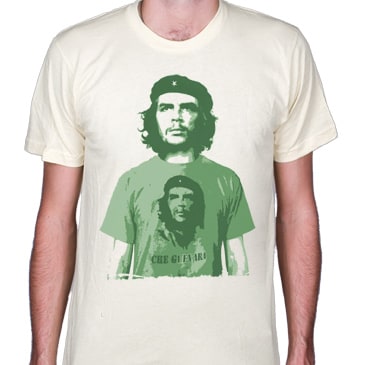
Rage Against The Machine instilled quasi-leftist values in a generation of politically illiterate young people. They provided late Gen-Xers with the language to discuss neo-Marxist beliefs and articulate unrest with Western governments. Yes, this disillusioned generation could now discuss politics and look convincing whilst sporting Che Guevara t-shirts, but they could not debate on the issues—it was more of a regurgitation of leftist ideals. They were literate in regards to politics, but not informed. You cannot debate simply by regurgitating rhyming couplets meant to be rapped atop a nu-metal backdrop. Moreover, this generation then made the misguided connection between their own unemployed plight and "evil" policies espoused by Western governments.

There is such a disconnect between the initial message Rage intended to spread through their music and the message that was interpreted and then misrepresented by their fans. People under the age of 30 tend to lean towards leftist ideals. In a quote often attributed to Sir Winston Churchill (though there is much debate as to whether he actually said it), he states that "Any man who is under 30 and is not a liberal has no heart; any man who is over 30 and is not a conservative has no brain." That being said, Rage appealed to a generation of youth who already were preconditioned towards certain leftist ideals. It helped their cause even more so that this generation was suffering through the recessive economy of the early 90s and a shortage of jobs due to a combination of the weak economy and the fact that the previous baby boom generation monopolized the job market. So, the disillusionment felt by these young men and women (mostly men though....how many female Rage fans have you met?) then morphed into a neo-Marxist political agenda—but a rather misinformed one at that. It is quite a leap to go from a general hatred of working at the GAP to espousing the invocations of class struggle and militaristic leftist revolution preached by a guerilla leader who has become a marketable symbol.

Let us not overlook the sad irony that Rage Against the Machine became a working mechanism within the greater machine that they took aim at. As anti-capitalist as Rage was, they themselves became a brand. Yes, this brand carried a message of left-wing ideals and bemoaned the actions of large corporations, but this brand also upheld much of what it crusaded against. By playing concerts promoted by Clear Channel, selling tickets through Ticketmaster, releasing albums through Epic Records (a subsidiary of Sony), selling albums at Best Buy, and packaging these albums in plastic cases made in China, Rage Against the Machine sit upon the apex of hypocrisy. In their defense, guitarist Tom Morello has argued that participation in the corporate realm of popular music is necessary to properly spread their message to the masses. Although I do agree to a certain extent, this ultimately proves that the machine cannot be stopped, let alone raged against. Ultimately, Rage's message is as misguided as that of their politically naïve fans.

Also, let us not forget that Rage paved the way for the rap-rock trend of the mid-to-late 90s, an unforgivable act that spawned the likes of Limp Bizkit, Crazy Town, Kid Rock (in his pre-country days), Head(pe), and even old KoRn. Nothing makes one more constipated than old corn.

What was I supposed to write about? Oh, right, Future of The Left. Ummm...enjoy.


9 November 2009

Wipe Your Tears Away

This week marks the 20th anniversary of the fall of the Berlin Wall and the collapse of Eastern European communism as a whole. As American sentiments would have you believe, The United States battled Eastern Bloc Communism and chipped away at its Iron Curtain propaganda machine and eventually won the Cold War, liberating Eastern Europeans. No single event sums up this freedom better than last week's MTV Europe Awards, which were held in Berlin.

Thanks to American-led liberation, Europe as a whole can freely hold an awards show that represents its ideals, musically anyway. Had the Iron Curtain never fallen, Europe would not have seen the likes of Katy Perry hosting its top music awards show. Nor would it have seen performances from Beyonce, Foo Fighters, Green Day, Jay-Z, and Shakira. Moreover, had America not freed Europe from the grips of Communism, there would not have been a Song of The Year award pitting the likes of The Black Eyed Peas, Beyonce, Lady GaGa, and Kings of Leon against each other.

Wait a second, none of the aforementioned artists are European. No, you're wrong, not Shakira either, she's from Columbia. You would think that Europe's top music awards show would aim to at least partially represent the continent for which it is named. I realize that American culture is renowned worldwide, but I do not believe that there are no European musicians who are equally as popular (in Europe anyway) as The Black Eyed Peas, Lady Gaga, and Kings of Leon (notice how I didn't mention Beyonce? I'm not going to even touch that one).

Well, at least Father Africa and The Kings of Ireland (otherwise known as U2) represented Europe with a historically sentimental performance in front of Brandenberg Gate, which served as a checkpoint along the Berlin Wall during the Cold War. Nothing says freedom like an aging band, who happens to be competing with Bon Jovi for a "Most Albums Released Far Past Their Prime" lifetime achievement award, playing a half-hearted rendition of one of their most powerful and politically cutting songs. Yes, a free performance by U2 of their 1983 hit "Sunday Bloody Sunday" in which Bono altered the emphasis on nearly every line in order to sound more like a diva had the streets of Berlin nearly as excited as when that famed politically divisive wall came down in 1989. If Bono's diva antics weren't enough to ruin the song and ultimately make you wish that the Berlin Wall had never fallen and you were caught on the Communist Eastern side where music, laughter, puppies, sole proprietorships, and bananas were outlawed, there was a special guest appearance during the song's bridge by self-proclaimed King of New York Jay-Z. That's right, Jay-Z tried to outdo Bono and actually make the song sound like audible excrement. He began a political freestyle that "name-dropped" election fraud in Iran and genocide in Rwanda among other worldwide political issues. Big-ups to Darfur, y'all. What up Israel apartheid.


I cannot even begin to address Bono's little rap near the end....

Once again, American culture managed to slither its way in and take credit for something in Berlin. The Iron Curtain fell because of a series of complex factors, the majority of which had very little to do with America. If anything, it was a softening of language by then-President Regan in regards to the USSR that was the main American contribution to the end of the Cold War. In contrast to the harsh words Regan had directed at the Soviets in the past, he adopted a more diplomatic and conciliatory tone in the late 80s. Beyond that, it was the revolutionary reforms in Soviet countries like Hungary, Poland, and Czechoslovakia and the bloody revolution in Romania that set the stage for the fall of the Berlin Wall and the demise of the Eastern Bloc.

One thing the Americans can certainly take credit for in Berlin, however, is the erosion of popular music and the tarnishing of a classic song about Irish civil rights.

5 November 2009

Municipal Misanthropy


The hot-button issue at City Hall this week is the proposal to levy a municipal sales tax to provide cash-strapped Toronto with a new source of revenue. Budget chief Shelly Carroll claims that Toronto is devoid of two key elements that other "global" cities possess: "A stable formula for sharing operating costs of public transit with the federal government, and revenue sources that grow with the economy." So, if the proposed municipal sales tax comes into effect, Toronto will at least possess the latter trait of Carroll's "global" city model.

Proponents of this initiative cite other world-class cities who long ago implemented a municipal tax. New York City levies a 4.5% tax on hotel rooms, restaurant bills, and admission charges. Chicago has an all-encompassing 1.25% sales tax as well as a 5-cent bottled water tax and a 9% fountain soft drink tax. These same proponents, one of them being former Winnipeg Mayor and potential Toronto Mayoral candidate for 2010, Glen Murray, claim that tourists should help support key parts of Toronto's infrastructure, like public transportation, through a municipal tax. Murray believes that otherwise, "Canadian cities end up subsidizing tourists’ transit rides without realizing any benefits."

Although I do support this notion to a certain extent, I find the timing of the proposal to be suspicious. Yes, a tax that only really targets tourists would be a wonderful source of revenue and would not affect Toronto residents. An additional 2%-or-so tax on a hotel bill will not dissuade travelers from coming to Toronto, but certainly will help fund municipal projects. Even something along the lines of Chicago's water bottle tax would be a great way to draw revenue from an unnecessary and environmentally damaging purchase. In fact, City Council missed a fine opportunity when it implemented the 5-cent fee for plastic bags this past Spring, as stores can use that extra revenue as they choose, rather than have it go directly to the city.

Ultimately, what draws my suspicion about this proposal is that it comes at the heels of another bold proposal by City Council: To take out a 30-year debenture for $600 million. Hmm. I'll let you make the connection and leave you with this...


2 November 2009

Timing is everything


A very unreliable source told me that in between The Strokes' 2003 album Room on Fire and 2006 album First Impressions of Earth, vocalist Julian Casablancas "quit drugs and alcohol" and that this lifestyle change accounts for how disappointing the third album is. I did not necessarily believe this theory, especially as it came from a college dropout Urban Outfitters lifer, but it did remind me why I should not work in retail, especially Urban Outfitters, and motivated me to work towards another degree (university lifer!). Furthermore, I do not find First Impressions to be a bad album nor do I believe it greatly differs stylistically from anything else in The Strokes catalogue, save opening track "You Only Live Once," which belongs in a commercial for GAP khakis.

Having only heard an instrumental snippet of Casablancas' solo album prior to its release, I concluded that the album would sound like a more electronic version of The Strokes. Considering that Casablancas is actually the primary songwriter in the band, this is not surprising. The majority of the songs in The Strokes' catalogue were originally written on keyboard by Casablancas and then brought to the rest of the band who would write their own individual parts based on the original structure. So essentially, Casablancas' solo album, Phrazes For The Young, simply avoids that second step in the songwriting process and takes a slightly different path. Every track on Phrazes is keyboard driven, often incorporating electronic drums and some subtle background guitar work.

Although Phrazes allows me to better appreciate Casablancas' ability as a songwriter, it still disappoints me overall. Without the extra elements added by the wealth of musical talent the Strokes possess, Casablancas' songs fall a little flat, with the exception of two tracks: opener "Out of The Blue" ultimately sounds like a typical Strokes song with its jangly treble-fueled guitar chords and jumpy bass; "River of Brake Lights" is a richly layered song, with noteworthy key changes, multiple arpeggio guitar riffs, and a heightened ending that allows Casablancas to wail the final few stanzas.

Although Julian Casablancas does have talent as a songwriter, he should stick to the formula that worked so well with The Strokes. Without the rest of the band his songs are undeveloped and forgettable overall.