
On Christmas day I began to compile my favourite albums of the 00's. Not necessarily because anyone really should care about my opinions, I mean we have the Hype Machine blog aggregator and the Conservative Party for that. AmIRight?! In fact, I began to do so out of sheer boredom.
Anyway, it ended up being a more daunting task than I initially assumed and have still not completed my list. Perhaps my commentary regarding each album is a little over the top and simply too long. I have decided to begin posting these albums in a few volumes as I edit the original entries (I was kind of drunk when writing them...)
Here it goes....
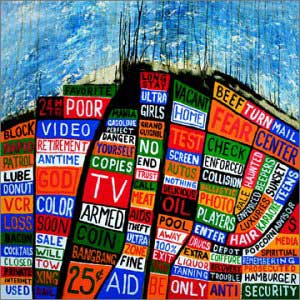
Yes, Kid A is a fantastic album and certainly helped shape the course of alternative rock for years to come. One must not ignore its significance in the cannon of music. The true songs on the album are weird, organic, pulsating, yet still poppy enough to be enjoyed by many. There are a few songs that are inaccessible and break up the album. Also, it is a fairly short album. As the turn of the century occurred, I noticed a reduction in tracks on albums. From this point on the average album only contained 10 tracks.
Yes, "Idioteque" certainly is one of the best songs ever. Other standouts on the album include "The National Anthem" and "Morning Bell." However, it is not a complete album. It lacks a distinct flow. It is a collection of songs that don't necessarily relate to each other. Some tracks utilize electronic experimentation and very little traditional rock band instrumentation. Then suddenly a track like "Optimistic" jumps out, that sounds like the Radiohead of OK Computerand throws the album off course. Ditto for follow-up (or connected b-side type album)Amnesiac.
Well, check this out. 2003's Hail to The Thief has 14 fucking tracks. Guess what else, jerkbutts? It starts out with a pretty straightforward rock song, "2+2=5." Ultimately, Hail to The Thiefmarks a return to the experimental art-rock of OK Computer, but with a newly informed perspective shaped by Kid A. Kid A might be one the most significant albums of the decade, butHail to The Thief is simply one of the best. Hail to The Thief is a depressing album. However, it is the kind of depressing that forces me to acknowledge feelings of grief and sadness that I typically try to avoid. Listening to the album and facing these emotions make me feel alive and ultimately provide me with a bittersweet happiness that I will never be able to properly articulate. Ah, diddums.
This album will stand out as the peak of the Deftones' career. By far one of the most underrated bands of the past decade, the Deftones were unfortunately grouped with nu-metal bands like Korn and Limp Bizkit in the early 00's and sludgy, slated-to-open-for-Nickelback, pop-metal bands like Breaking Benjamin in the later years of the decade. I could go so far as to make a Rodney Dangerfield reference, but I won't. You know, Rodney Dangerfield? Really? Fuck.
White Pony is an album abound with the full breadth of Chino Moreno's vocal depth. He wails. He moans. He whispers. He screams. He even croons. All done so in his specific off-kilter way, where often you cannot tell if he is slightly off-key or hitting special notes that only dogs can hear.
The songs themselves reach far beyond the realm of metal. Yes, the chugging riffs are still present, but so are smoother melodic touches on tracks like "Digital Bath," "Korea," and "Pink Maggit." Ambient electronic flourishes complement nearly every track on the album and especially stand out on "Change (In The House of Flies)," "Passenger," and "Teenager."
Moreno's lyrics are as ambiguously cryptic and morbid as ever on this album and are even more resonant when sung in his manic, whispery manner atop a background of distorted guitars, ambient noise, and soothing beats. White Pony is an album that could never be fully comprehended by the Deftones' Ozzfest-attending fans and was written off by nay-saying elitists who branded the band as another rapscallion nu-metal group. However, White Pony is a progressive, introspective, manic depressive album that deserves deeper thought and greater recognition.

By now, Damon Albarn is a household name even here "across the pond, in the colonies." If you don't know him for singing that "woohoo" song with Blur, you possibly know him for the many characters of the Gorillaz. If you don't know him for either of those then you're a jabberwocky.
What even less people know him for is his brief "superband" that was often referred to as The Good, The Bad, And the Queen. In fact, that is the name of the album released by the Albarn-fronted superband. The band itself chose to be nameless.
The other members of this superband include: former bassist of the Clash, Paul Simonon, who wrote and sang what is arguably one of the band's best songs, "Guns of Brixton;" former guitarist for The Verve (you know, those guys who "stole" part of a Rolling Stones song), Simon Tong; Afrobeat pioneer and drumming virtuoso Tony Allen. Together, the four men releasedThe Good, The Bad, And The Queen, a one-off album by a supergroup that feels as though it was written by a veteran band that has been together for years and put out a culminating album that brings all their strengths to the table in a perfectly balanced way. By no means is it a forced supergroup kind of album in which each musician fights to put forth his greatest strength, like those Chicken Foot assholes.
The Good, The Bad, and The Queen is a well-thought out, well-produced (by that Danger Mouse chap), and well-executed album that is never overstated. Every track has a wonderful hook that is not overtly presented, but is still prevalent enough that it politely tugs at your collar and forces you to nod your head. Tony Allen's percussion is often so subtle you barely notice it, but when teamed with Paul Simonon's reggae-influenced bass lines a solid, groove-heavy rhythmic backbone is established. Simon Tong's guitar playing is never too prominent on any song, rather it either adds ambiance or complements Albarn's falsetto piano. Finally, Albarn's lyrics (many of which were written with Simonon's assistance) follow a conceptual path, as each song is about a different aspect of modern life in London.
This album is the product of four well-travelled and extremely talented musicians coming together, putting egos aside, and simply crafting a fantastic piece of art. Spot on.
